

Why Traditional IT Recruitment Is More Expensive Than It Looks
An eye-opening financial breakdown showing CEOs and CFOs why traditional IT recruitment costs far more than base salaries and how staff augmentation eliminates hidden hiring overhead.
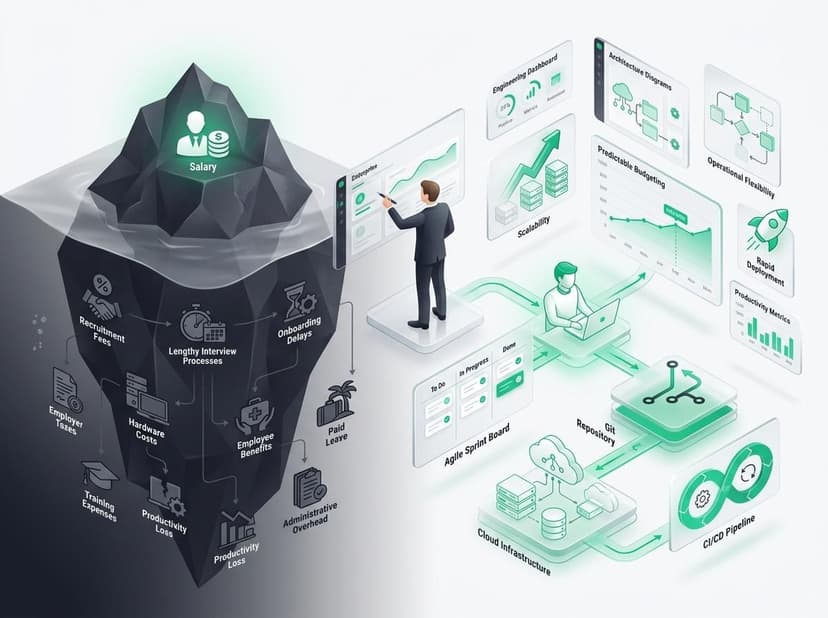
When planning your engineering budget, looking only at a software developer's gross monthly salary is a dangerous financial oversight. For a CEO or CFO, a direct hire looks like a fixed, predictable cost. In reality, traditional tech recruitment is fraught with hidden fees, lost productivity, and sunken resource costs that rarely show up clearly on a standard P&L statement.
In a highly competitive tech market, the true cost of acquisition and retention is skyrocketing. This guide breaks down the real mathematics behind traditional IT recruitment and contrasts it with the lean financial model of staff augmentation.
1. Deconstructing the True Cost of a Direct Hire
To understand where your capital is leaking, we must map out the entire lifecycle of a permanent hire—from the first job posting to the end of their first year.
- The Recruitment Sourcing Fee: Most internal HR teams lack the specialized networks to source niche tech talent (e.g., Senior DevOps or Cloud Architects). Turning to external recruitment agencies usually incurs a success fee ranging between 15% and 25% of the candidate's gross annual salary. For a senior engineer making €80,000 a year, that is an immediate upfront cash outflow of €12,000 to €20,000 before they even write their first line of code.
- The Engineering Interview Drain: The biggest hidden cost is not the recruiter's fee; it is the time your internal team spends not building your product. A standard tech hiring funnel requires: HR screening (30 mins), Technical assignment review by a Senior Developer (1–2 hours), Live technical interview with the Tech Lead/CTO (1.5 hours), Cultural fit interview (1 hour). If your team interviews 10 candidates to make one offer, your highest-paid internal engineering assets have spent roughly 30 to 40 hours in interviews and reviews instead of shipping revenue-generating features.
- The Onboarding and Ramp-Up Drag: A permanent employee rarely hits 100% productivity in month one. On average, a new developer takes 45 to 90 days to fully master a complex, legacy codebase and match the velocity of the existing team. During this ramp-up period, you are paying 100% of the salary for roughly 30% to 50% of the output.
2. Key Operational Vectors Compared
- Upfront Sourcing Fee: Traditional Direct Hire is 15%–25% of annual salary; IT Staff Augmentation is €0 (included in rate).
- Interview Overhead: Traditional Direct Hire is high (drains internal tech leads); IT Staff Augmentation is minimal (pre-vetted shortlists only).
- Benefits & Overhead: Traditional Direct Hire includes health, hardware, office, bonuses; IT Staff Augmentation is €0 (borne entirely by vendor).
- Paid Downtime: Traditional Direct Hire pays sick leave, vacations, bench time; IT Staff Augmentation pays only for active hours worked.
- Termination & Attrition Risk: Traditional Direct Hire is high (severance, legal limits); IT Staff Augmentation is zero (immediate replacement or scaling).
3. The True Math: A Model First-Year Comparison
Let's look at a realistic scenario for a Senior Software Engineer in Central Europe with a base salary of €6,500/month (€78,000/year).
Traditional Direct Hire (Year 1)
- Base Gross Salary: €78,000
- Recruitment Fee (20%): €15,600
- Employer Taxes/Contributions (approx. 35%): €27,300
- Internal Interview Overhead (Engineering hours): €2,500
- Hardware, Software Licenses & Workspace: €4,000
- Perks, Training, and Perks: €2,000
- Total Year 1 Investment: €129,400
IT Staff Augmentation Model
- All-Inclusive Hourly Rate billing: You pay a flat, predictable invoice based entirely on time and material.
- HR, Taxes, Hardware, Benefits, and Sourcing: Covered entirely by the vendor.
- Total Year 1 Investment: Scaled precisely to your project needs, with zero hidden financial trailing liabilities if you need to downscale after 6 months.
Conclusion: Mitigating Risk in an Uncertain Market
Direct hiring makes sense when you are locking in core, generational talent for your company's proprietary technology. However, using direct hiring to handle seasonal roadmap spikes, temporary migrations, or unvalidated new product lines is a massive financial risk.
By leveraging an IT staff augmentation model, you protect your cash flow, eliminate upfront recruitment sunk costs, and gain the agility to scale down your operational expenses the exact moment your roadmap demands it.
Stop draining your engineering leadership's time with endless sourcing and interviewing. At Logamic, we absorb the overhead and deliver pre-vetted, high-performing IT talent directly to your workflow. Let us help you optimize your tech budget today.
Related articles
April 12, 2026
The CTO’s Guide to IT Sourcing Models
A practical guide for CTOs comparing In-House Hiring, Agencies, and IT Staff Augmentation to help engineering leaders choose the best model for scaling their tech teams efficiently.

April 12, 2026
Speed-to-Deploy: Hire IT Talent in 72 Hours
Discover how deploying senior engineers within 72 hours eliminates recruitment lag, protects sprint velocity, and gives tech leaders a decisive competitive advantage.

April 12, 2026
IT Sourcing in Central Europe: The Nearshore Advantage
Learn why European tech leaders are replacing offshore vendors with CEE nearshore staff augmentation for zero time-zone friction and maximum cost efficiency.