

Staff Augmentation vs. Fixed Price: Which Saves More?
A commercial guide for tech executives comparing Fixed Price, T&M, and Staff Augmentation to maximize ROI and maintain agility in modern software development.
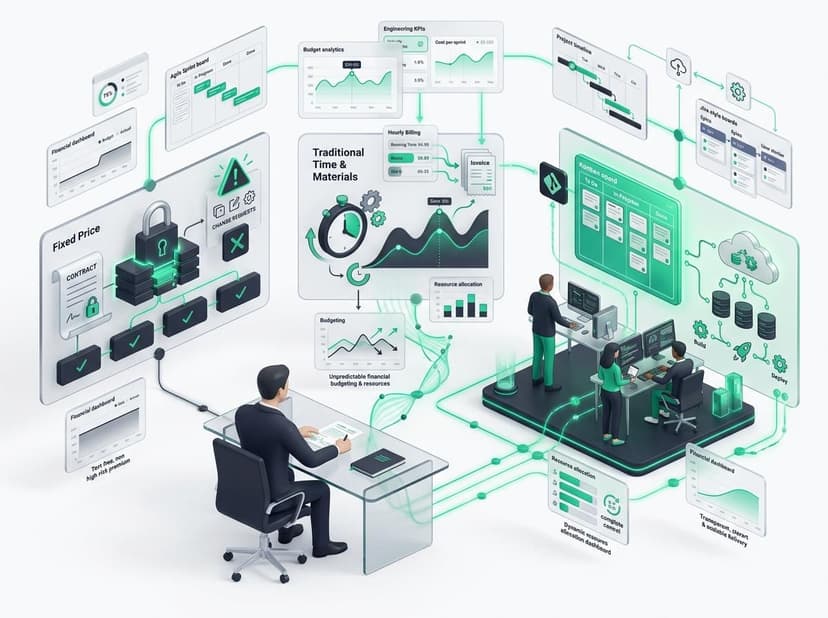
Fixed Price zaps agility by imposing massive premiums for change requests. Traditional Time & Materials offers zero resource predictability. IT Staff Augmentation (Bodyshopping) provides the optimal financial framework for modern software development—offering flat, predictable monthly T&M billing combined with total control over resource allocation and prioritization.
For a CEO, CFO, or Procurement Manager, signing an IT vendor agreement comes down to two variables: risk management and cost control. When expanding your development capabilities, the choice of engagement model—Fixed Price, Traditional Time & Materials (T&M), or Staff Augmentation—determines who bears the financial burden of changing requirements, scope creep, and engineering delays.
In modern agile software development, requirements shift constantly as user data and market conditions evolve. Here is a clear commercial breakdown of the three primary engagement models to help you identify which framework offers the highest ROI for your budget.
1. The Myth of the "Safe" Fixed Price Contract
On paper, a Fixed-Price contract looks like the safest option for a CFO. You give the vendor a specification document, they give you an exact price and delivery date, and you assume your financial risk is capped at zero.
In practice, Fixed Price is often the most expensive and restrictive model for software engineering.
- The Risk Premium: To protect themselves against unexpected technical complications, vendors routinely add a 30% to 50% buffer premium into their initial fixed quote. You are paying for risk that might not even manifest.
- The Change-Request Trap: Software requirements are rarely static. The moment your team needs to pivot a feature or alter a data flow mid-project, the vendor halts development to calculate a "Change Request." This leads to lengthy contract renegotiations, delayed timelines, and inflated custom billing that erodes any initial budget predictability.
2. Structural Matrix of IT Engagement Models
- Pricing Predictability: Fixed-Price Projects is Fixed upfront (with high risk premiums); Traditional Time & Materials is Variable / Unpredictable; IT Staff Augmentation (Bodyshopping) is Highly Predictable (Flat monthly/hourly rates).
- Scope Flexibility: Fixed-Price Projects is Extremely Rigid (Change requests required); Traditional Time & Materials is High (Pay for hours worked); IT Staff Augmentation (Bodyshopping) is Absolute (You redirect tasks dynamically in sprints).
- Risk of Sunk Costs: Fixed-Price Projects is Paid regardless of code usability or debt; Traditional Time & Materials is Paid entirely based on hours; IT Staff Augmentation (Bodyshopping) is Minimal (Only pay for active, vetted resource delivery).
- Management Control: Fixed-Price Projects is Vendor PM handles team completely; Traditional Time & Materials is Shared / Fragmented; IT Staff Augmentation (Bodyshopping) is Your internal Tech Lead maintains 100% control.
3. Staff Augmentation: Highly Flexible T&M
IT Staff Augmentation takes the best parts of the Time & Materials model (paying only for the actual value delivered) and wraps it in a predictable resource allocation framework.
Under this structure, you secure highly qualified engineering resources at a set hourly or monthly rate. They function as part of your internal team, allowing you to change course, refine architectures, reprioritize backlogs, or scale down capacity instantly without trigger-happy legal teams demanding a contract amendment for every minor adjustment. You maintain total visibility over where every cent is spent because the engineers log time directly against your internal Jira tasks.
Conclusion: Aligning Contracts with Agile Realities
If you are building a simple, repetitive brochure website with a static scope, a Fixed-Price contract works fine. But if you are building complex web applications, modern SaaS platforms, cloud architectures, or data pipelines, you need an agile model.
IT Staff Augmentation eliminates the artificial cost buffers of fixed contracts while giving your leadership team the complete operational control, speed, and budget flexibility required to ship great software efficiently.
Looking for maximum transparency and ROI for your software development budget? At Logamic, we offer clear, predictable, and highly flexible billing structures tailored precisely to your agile sprint requirements. Contact us today to optimize your engineering expenses.
Related articles
April 12, 2026
The CTO’s Guide to IT Sourcing Models
A practical guide for CTOs comparing In-House Hiring, Agencies, and IT Staff Augmentation to help engineering leaders choose the best model for scaling their tech teams efficiently.

April 12, 2026
Speed-to-Deploy: Hire IT Talent in 72 Hours
Discover how deploying senior engineers within 72 hours eliminates recruitment lag, protects sprint velocity, and gives tech leaders a decisive competitive advantage.
April 12, 2026
Why Traditional IT Recruitment Is More Expensive Than It Looks
An eye-opening financial breakdown showing CEOs and CFOs why traditional IT recruitment costs far more than base salaries and how staff augmentation eliminates hidden hiring overhead.