

Cut IT Onboarding Time to 3 Days
Slow developer onboarding is a management failure, not a talent failure.

The most common objection a CTO has when considering an external IT bodyshop is the integration bottleneck. The prevailing myth is that an external contractor will spend their first month just trying to get their local Docker environment running, figuring out the architecture, and understanding team dynamics—meaning the company loses money during the setup phase.
However, in modern agile environments, prolonged onboarding is a symptom of fragmented documentation and poor engineering governance. When structured correctly, an augmented developer—who is already a highly skilled professional—can and should be contributing to your codebase within 72 hours. Here is the operational framework to make that happen.
1. The Separation of Concerns in Developer Onboarding
The secret to rapid integration is separating Product Domain Logic from Engineering Environment Readiness.
An external developer does not need to understand your 5-year corporate business strategy to fix a critical database bottleneck or build an API endpoint. They simply need clean code boundaries, clear definitions of done, and an environment that builds without errors.
2. The 3-Day Integration Playbook
- Day 1 (Access & Environment): Core deliverables include Identity Management (IAM), Repo Clones, and Local Build. The success metric is that the dev environment runs green locally.
- Day 2 (Architecture & Sandbox): Core deliverables include a walkthrough of design patterns and assigning the first low-risk Jira ticket. The success metric is code drafted in a local branch.
- Day 3 (Execution & Deployment): Core deliverables include the first Pull Request (PR) submission to staging. The success metric is code reviewed, approved, and merged.
3. Step-by-Step Execution Guide
Day 1: Eliminating the Access Bottleneck
Do not waste Day 1 waiting for your IT helpdesk to grant individual repository permissions. Implement a standardized onboarding checklist using an Identity Provider (like Okta or Google Workspace) where external contractors are automatically assigned to predefined developer roles.
- The Goal: By 12:00 PM on Day 1, the developer must have access to Slack/Teams, Jira, Confluence, GitHub/GitLab, and cloud sandboxes.
- The Documentation: Your repository must include a fully updated
README.mdfile. A single command (e.g.,make setupordocker-compose up) should spin up the entire local stack without requiring manual tweaks or missing environment variables.
Day 2: The Technical Context & The "Tech Buddy"
Pair the incoming augmented developer with a senior member of your internal team. This internal engineer acts as their "Tech Buddy" for the first week.
- The System Walkthrough: Conduct a 1-hour high-level architectural review (ideally recorded on Loom for future reuse). Explain data flows, core microservices, and known architectural debt.
- The Low-Risk Ticket: Assign a well-defined, low-risk task—such as writing a unit test, updating a straightforward API schema, or fixing a minor UI bug. This forces the developer to run through your entire development lifecycle (pull, branch, test, push) without risk to core business logic.
Day 3: The First Pull Request
By Day 3, the external engineer should open their first Pull Request. This is the ultimate test of your onboarding pipeline.
- Testing the CI/CD Pipeline: This initial PR validates that the developer understands your team's code formatting rules, linting standards, and testing suites.
- Feedback Loop: Your internal team reviews the code, provides feedback, and merges it into the staging environment. The psychological impact of shipping code on Day 3 instantly aligns the external developer with your team's momentum.
Conclusion: Onboarding is an Infrastructure Asset
A streamlined, 3-day onboarding framework doesn't just benefit external developers; it forces your internal engineering team to maintain clean documentation, clear repository boundaries, and automated environments. This reduces technical friction across your entire department.
When you partner with a premium IT staff augmentation provider, you are bringing in seniors who are experts at adapting to new stacks rapidly. Combined with a tight onboarding playbook, you eliminate downtime and accelerate velocity immediately.
Related articles

April 12, 2026
The CTO’s Guide to IT Sourcing Models
A practical guide for CTOs comparing In-House Hiring, Agencies, and IT Staff Augmentation to help engineering leaders choose the best model for scaling their tech teams efficiently.

April 12, 2026
Speed-to-Deploy: Hire IT Talent in 72 Hours
Discover how deploying senior engineers within 72 hours eliminates recruitment lag, protects sprint velocity, and gives tech leaders a decisive competitive advantage.
April 12, 2026
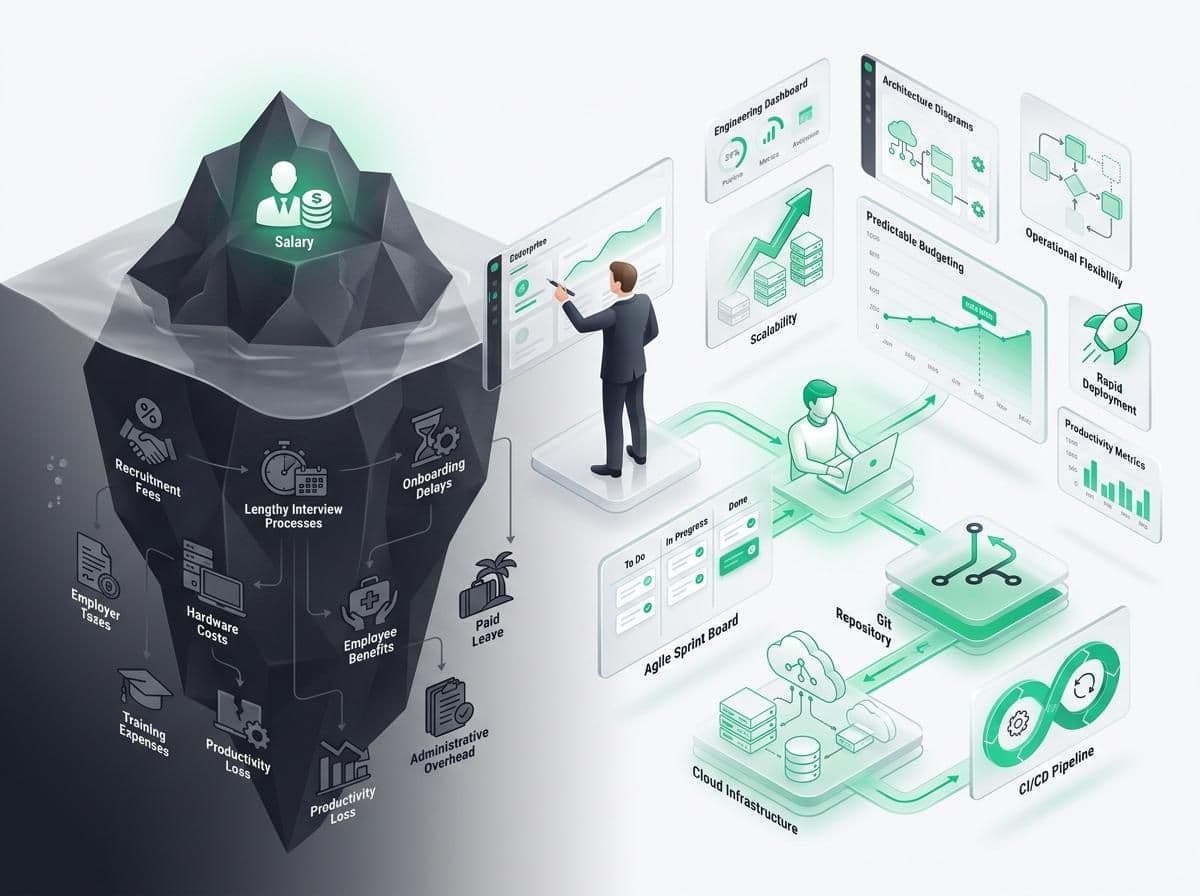
Why Traditional IT Recruitment Is More Expensive Than It Looks
An eye-opening financial breakdown showing CEOs and CFOs why traditional IT recruitment costs far more than base salaries and how staff augmentation eliminates hidden hiring overhead.